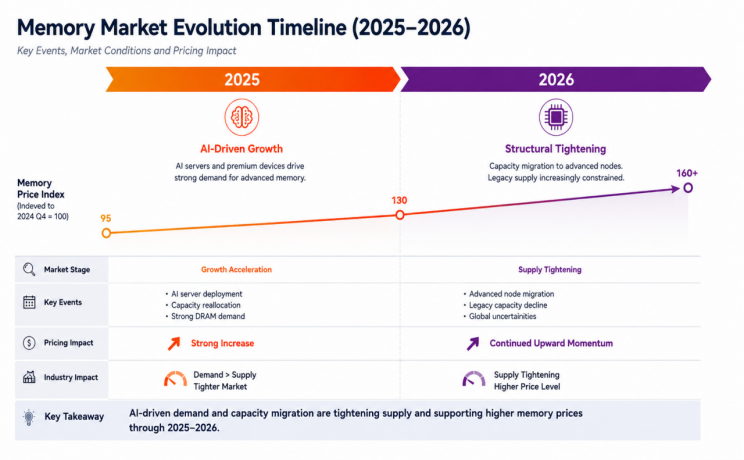
For decades, memory pricing tracked PC and smartphone demand cycles. That era has ended. Today, capacity allocation, AI infrastructure investment, technology migration, and geopolitics are the dominant forces — making pricing less responsive to traditional demand and far more complex for procurement.
Figure: Memory market evolution — from cyclical demand swings to structural supply-driven dynamics
I. AI Demand as a Core Anchor
AI remains the primary driver of memory demand
Micron reports sustained strength in AI-driven memory and HBM growth (Source: Q3 FY2026 Earnings)
AI infrastructure directly supports advanced DRAM pricing
Suppliers increasingly allocate capacity based on AI demand
II. Capacity Shifts Reshape Supply
Samsung and SK Hynix expanding HBM production capacity
Next-generation memory prioritised over legacy nodes
Legacy DRAM and NAND output expected to remain constrained long-term
Supply tightening across automotive, industrial, and embedded segments
III. Disciplined Supply Management, Not Demand Recovery
Major suppliers maintaining cautious production discipline
Pricing stability supported by structural supply management (Source: Counterpoint)
No broad consumer demand recovery required to sustain current pricing
IV. Recent Pricing Trajectories (2025–2026)
Segment
Key Products
Trend
DRAM
DDR3 / DDR4
Sustained upward momentum as legacy supply tightens
DRAM
LPDDR4
Sharp rise driven by automotive (ADAS, intelligent cockpit) and industrial demand
NAND Flash
eMMC
Notable appreciation from early 2026 on tighter NAND supply and shift to premium storage
Inside the Full Report:
✔️ Model‑by‑model pricing trends for DDR3, DDR4, LPDDR4, and eMMC
✔️ Supplier capacity allocation and production discipline analysis
✔️ AI's impact on advanced DRAM pricing and legacy supply
✔️ Strategic procurement recommendations for the new market reality
Click the Download button below for the complete report.
✅ For additional sourcing support or to learn more, feel free to reach out at: